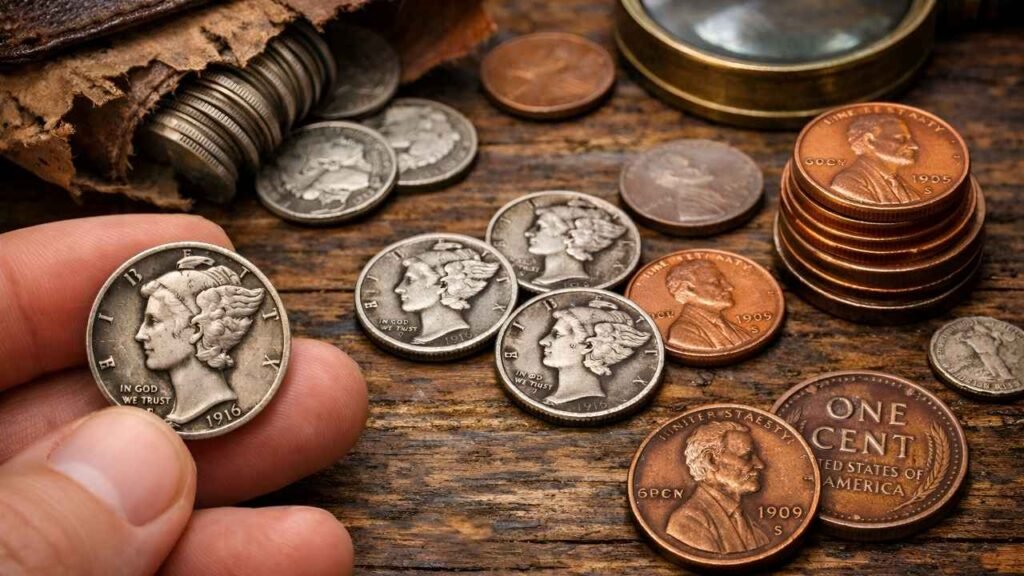
Do you have old coins lying around in your drawer or piggy bank? Some Mercury dimes and Lincoln pennies look ordinary but can be hidden treasures worth a lot of money. These small U.S. coins from the early 1900s are popular with collectors because of their history, low numbers made, special mint marks, and minting errors. In 2026, certain rare versions still fetch high prices at auctions—sometimes thousands or even millions of dollars!
Coin collecting (called numismatics) is fun and can be profitable. Many people find valuable coins in old jars, family collections, or even pocket change. Let’s explore why these coins are special and look at some of the rarest ones.
What Are Mercury Dimes?
Mercury dimes were made from 1916 to 1945. (Note: The lady on the front is Liberty with wings on her cap, not the planet Mercury—that’s why it’s officially called the Winged Liberty Head dime.)
- Front side: Shows Liberty with a winged cap (symbol for freedom of thought).
- Back side: Has a bundle of sticks (fasces for strength) and an olive branch (for peace).
- Material: 90% silver, so they have some melt value too.
- Why some are rare: Low numbers produced in certain years, special mint locations (like “D” for Denver or “S” for San Francisco), and errors.
These coins were used a lot in daily life, so finding one in perfect shape is hard and makes it very valuable.
What Are Lincoln Pennies (Wheat Cents)?
Lincoln pennies started in 1909 to honor Abraham Lincoln’s 100th birthday. The “Wheat” version (with wheat stalks on the back) ran until 1958.
- Front side: Abraham Lincoln’s portrait.
- Back side: Two wheat ears (that’s why called Wheat pennies).
- Material: Mostly copper (except some wartime steel versions).
- Why some are rare: Very low production in early years, famous initials like “VDB,” and big errors like doubled words or wrong metal.
Billions of pennies were made overall, but specific rare ones stand out.
Key Factors That Make These Coins Valuable
Several things decide if a coin is worth a lot:
- Low mintage (few made).
- Mint mark (small letter showing where made: no letter = Philadelphia, D = Denver, S = San Francisco).
- Condition (graded on a scale; MS65+ means almost perfect, no wear).
- Errors (mistakes like doubled designs, off-center strikes, or wrong planchet/metal).
- Demand from collectors and investors.
High-grade (top condition) rare coins can sell for much more than worn ones.
Top 20 Ultra-Rare Mercury Dimes and Lincoln Pennies (With Approximate Values in Top Condition)
Here is a table of 20 highly sought-after examples. Values are rough estimates for high-grade coins (MS60+ or better) based on recent auction trends and guides—actual prices vary by exact condition and market.
| # | Coin Name | Year & Key Feature | Why Rare | Approx. Value (High Grade) |
|---|---|---|---|---|
| 1 | Mercury Dime | 1916-D | Lowest mintage in series | $650 – $40,000+ |
| 2 | Mercury Dime | 1921 | Very low production | $35 – $23,500+ |
| 3 | Mercury Dime | 1921-D | Low mintage from Denver | $40 – $28,800+ |
| 4 | Mercury Dime | 1942/1 Overdate | Error: 2 punched over 1 | $300 – $26,000+ |
| 5 | Mercury Dime | 1919-D | Scarce in good condition | $220 – $3,000+ |
| 6 | Mercury Dime | 1926-S | Low mintage | $915 – $3,100+ |
| 7 | Mercury Dime | 1925-D | Low production | $415 – $1,800+ |
| 8 | Mercury Dime | 1927-S | Scarce San Francisco issue | $300 – $1,500+ |
| 9 | Lincoln Wheat Penny | 1909-S VDB | Famous low mintage + initials | $500 – $100,000+ |
| 10 | Lincoln Wheat Penny | 1914-D | Very low mintage | $200 – $15,000+ |
| 11 | Lincoln Wheat Penny | 1922 No D (Plain) | Mint mark missing error | $500 – $57,500+ |
| 12 | Lincoln Wheat Penny | 1943 Bronze (Copper) | Wrong metal during WWII | $200,000 – $1.7 Million+ |
| 13 | Lincoln Wheat Penny | 1955 Doubled Die Obverse | Strong doubling on words/dates | $1,000 – $35,000+ |
| 14 | Lincoln Wheat Penny | 1944-S Steel | Wrong metal error | $75,000 – $400,000+ |
| 15 | Lincoln Wheat Penny | 1931-S | Low mintage | $50 – $10,000+ |
| 16 | Lincoln Wheat Penny | 1969-S Doubled Die | Dramatic doubling | $35,000 – $125,000+ |
| 17 | Lincoln Wheat Penny | 1926-S | Scarce in high grade | $100 – $10,000+ |
| 18 | Lincoln Wheat Penny | 1917 Doubled Die | Early error variety | Varies, up to thousands |
| 19 | Mercury Dime | 1925-S | Low mintage San Francisco | $200 – $1,500+ |
| 20 | Lincoln Wheat Penny | 1958 Doubled Die | Last year Wheat + error | Up to $336,000 (records) |
Tips for Finding and Collecting These Rare Coins
- Learn to spot key dates and mint marks—use a magnifying glass.
- Buy graded coins (from services like PCGS or NGC) for safety.
- Store coins in protective holders to avoid damage.
- Check old coin rolls, inherited boxes, or flea markets.
- Be patient—big finds take time and knowledge.
- Start small and build your collection slowly.
Conclusion: Start Your Treasure Hunt Today!
Mercury dimes and Lincoln Wheat pennies prove that everyday items from the past can become incredibly valuable. Whether due to rare production years, exciting mint errors, or perfect condition, these 20 ultra-rare examples show the thrill of coin collecting. Some are worth thousands, while a few legendary ones have sold for millions!
If you think you have one of these, get it checked by a professional. Coin hunting is an exciting hobby that connects you to history and might even pay off big. Keep an eye on your change—you never know what treasure you might find next! Happy collecting!