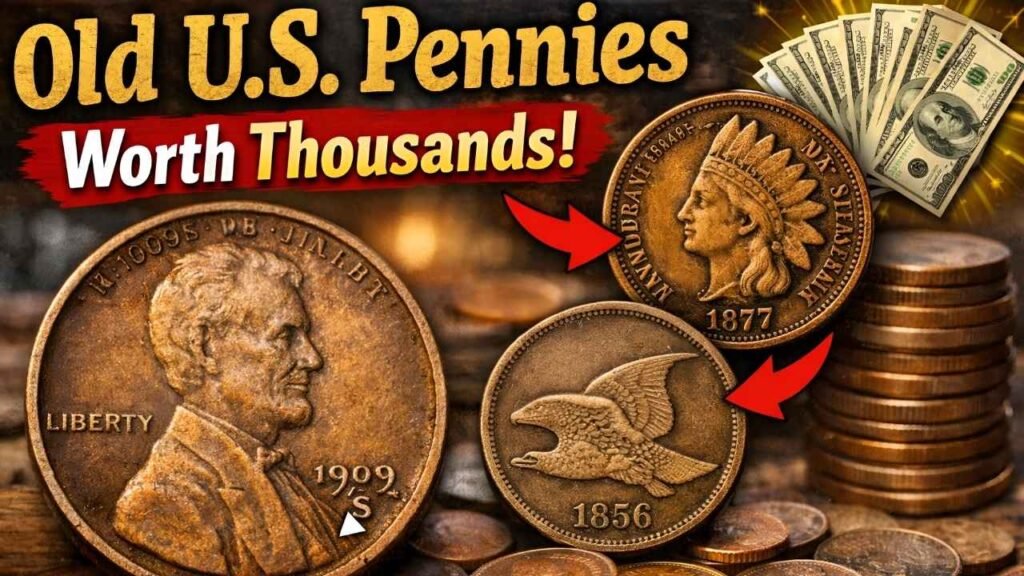
Have you ever found an old penny in your pocket, jar, or old box and thought it was just loose change? Think again! Some old U.S. pennies, especially from the early 1900s, look plain or dirty but can be worth thousands of dollars to coin collectors. These rare coins often hide in plain sight because of wear, dirt, or small mistakes made during minting. In recent years, collectors have paid big money for them at auctions.
This guide explains why some old pennies are so valuable, lists the most sought-after ones, and shares simple tips to check your own coins. You don’t need to be an expert—just know what to look for.
A Quick Look at U.S. Penny History
The U.S. penny has changed over time. Early ones were large and made of pure copper. Later, in 1909, the Lincoln penny started, showing President Abraham Lincoln on the front and wheat stalks (called “wheat pennies”) on the back until 1958.
Many valuable pennies come from the Lincoln wheat series (1909–1958). Their value comes from low production numbers, special mint marks (like “S” for San Francisco or “D” for Denver), or errors during production. Even if a coin is worn or dirty, rarity makes it valuable—not just how shiny it is.
Why Dirty or Worn Pennies Can Still Be Worth a Lot
Many people throw away old, dirty pennies because they look bad. But collectors care more about rarity, history, and any unique features than perfect looks. Dirt, scratches, or tarnish (a green or brown layer) don’t destroy value if the coin is rare.
Grading companies like PCGS or NGC check and rate coins. They focus on authenticity and key details. A dirty rare penny can still sell for thousands after cleaning (done carefully) and grading.
Top Rare Old U.S. Pennies Worth Thousands
Here are some of the most famous valuable old pennies. Values depend on condition (how worn they are), but even lower-grade ones can fetch hundreds or thousands.
1909-S VDB Lincoln Wheat Penny
This is one of the most famous rare pennies. The “VDB” initials of the designer (Victor David Brenner) appear on the back, but only a small number were made with them before the mint removed them. Minted in San Francisco (“S” mark), only about 484,000 were produced.
Even worn examples sell for $700–$2,000+, while top-condition ones have reached over $1 million at auction.
1943 Copper Lincoln Penny
In 1943, pennies were made of steel (coated in zinc) to save copper for World War II. But a few were accidentally made from copper (leftover from 1942). These are super rare—only about 20–40 exist.
Values start at $100,000+ for most, with some selling for over $1 million or even $2 million in top shape.
1955 Doubled Die Lincoln Penny
This error coin shows clear doubling on words like “LIBERTY,” “IN GOD WE TRUST,” and the date. It happened when the design die was stamped twice slightly off.
Even circulated (worn) ones sell for $1,000+, and high-grade examples go for $10,000–$50,000 or more.
1922 No D Lincoln Penny
Made in Denver, but the “D” mint mark is missing due to a worn die. The strong reverse (back design) versions are especially valuable.
Values range from $500–$1,000 for basic ones to $10,000–$30,000+ for better examples.
1914-D Lincoln Wheat Penny
Low production in Denver—only about 1.2 million made. It’s a key date for collectors.
Worn ones sell for $200–$500, while nicer ones reach $10,000+.
Other notable ones include:
- 1931-S Lincoln Penny (low mintage, $50–$300+)
- 1944 Steel Penny (error, opposite of 1943—made on steel instead of copper, $75,000+)
Common Penny Errors That Boost Value
Errors happen when something goes wrong at the mint. These make coins unique and valuable.
- Doubled Die: Design looks doubled (like the 1955 or 1969-S versions).
- Off-Center Strike: Design is not centered—part is missing.
- Wrong Planchet: Struck on wrong metal (like copper in 1943 or steel in 1944).
- Repunched Mint Mark: Mint mark punched twice.
These errors can turn a normal penny into one worth thousands.
Valuable Old Pennies Quick Reference Table
| Penny Type | Year | Key Feature/Error | Approximate Value Range (Depending on Condition) |
|---|---|---|---|
| 1909-S VDB Lincoln | 1909 | VDB initials, “S” mint | $700 – $1,000,000+ |
| 1943 Copper Lincoln | 1943 | Copper instead of steel | $100,000 – $2,000,000+ |
| 1955 Doubled Die Lincoln | 1955 | Clear doubling on front | $1,000 – $50,000+ |
| 1922 No D Lincoln | 1922 | Missing “D” mint mark | $500 – $30,000+ |
| 1914-D Lincoln | 1914 | Low mintage “D” | $200 – $10,000+ |
| 1944 Steel Lincoln | 1944 | Steel instead of copper | $75,000 – $1,000,000+ |
(Note: Values are estimates based on recent sales and guides; always get professional grading for accuracy.)
How to Check If You Have a Valuable Penny
- Look at the date and mint mark (small letter under the date: “S” = San Francisco, “D” = Denver, no letter = Philadelphia).
- Use a magnifying glass to check for doubling, missing marks, or odd strikes.
- Don’t clean coins harshly—rubbing can lower value. Rinse gently with water if needed.
- Compare to online guides or books like the Red Book.
- If it looks promising, take it to a coin dealer or grading service for expert help.
Final Thoughts: Hidden Treasures in Your Change
Old U.S. pennies prove that looks can be deceiving. A dirty, worn coin from your grandparents’ drawer or a jar of loose change might be worth thousands due to rarity, history, or a mint mistake. Coin collecting connects you to the past while offering real financial potential.
Start by checking your old coins today—you never know what treasure you might find. Learn more about dates, mint marks, and errors, store coins safely in holders, and enjoy the hunt. Who knows? Your next penny could change everything!